
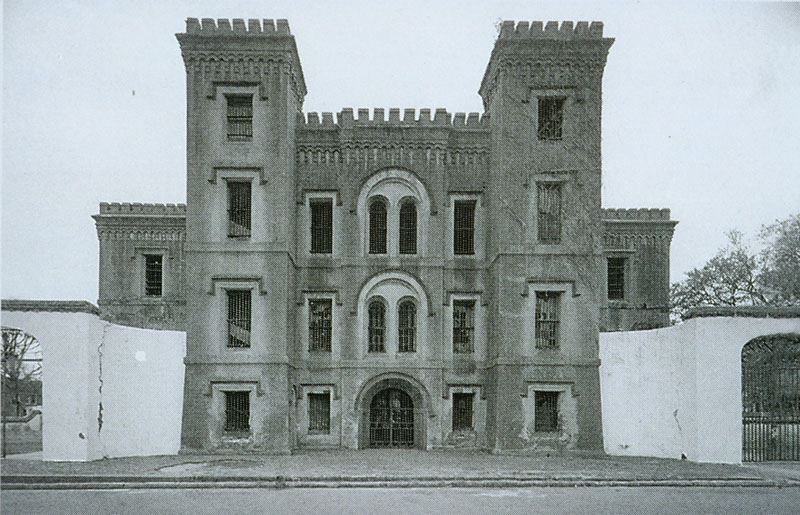
If you live in or visit Charleston, you have probably heard the name, Lavinia Fisher. Her name is uttered more often this time of year when people repeat ghost stories and legends in celebration of Halloween. Charleston is known for its many ghost stories and there is a vibrant tourist business surrounding the paranormal and ghastly stories of murder. And while there were many murderous deeds committed in Charleston, the stories surround Lavinia have become more fiction than fact over the years.
The legend of Lavinia Fisher claims that she was the first female serial killer to be executed in the United States. The story that most people hear goes like this. Lavinia and her husband John owned an Inn called Six Mile Wayfarer House, which as the name implies, was located six miles outside of town. Lavinia was said to be a charming and attractive 27-year-old woman. Travelers coming in and out of Charleston began to be reported missing and people in the area began suspecting the couple. A group of vigilantes was organized to go to the Inn and conduct an investigation. The group did not find anything but left a man named David Ross there to keep watch. He was attacked in the early morning by two men and then brought before a group of mostly men. Lavinia Fisher was in the group and is said to have choked him and then smashed his head through a window. Ross was able to escape and went back to Charleston to report what had happened.
Around the same time, a traveler from Georgia named John Peoples came to the Inn on his way to Charleston. He was offered a meal and tea but was told there were no rooms available. After chatting a while with the proprietors, Lavinia excused herself to make him so tea and when she returned she told him that a room had opened up if he was still interested which he said that he was. John decided that he did not want the tea that had been brought to him, but instead of appearing rude he emptied his mug when the proprietors were not looking. John was eventually shown up to his room but by this time had begun to get an uneasy feeling. He decided to sleep in a chair in the room instead of in the bed. At some point in the night, John awoke from a loud sound and realized that the bed had disappeared into a hole in the floor. He is said to have escaped through the bedroom window and rushed to report what happened to the Charleston authorities.
The authorities came to arrest the Fishers as well as two other men who worked at the Inn. It is said that during their search of the Inn they found items belonging to dozens of travelers, secret passageways, a trap door in the bedroom, as well as a substance that could be used to make someone sleep for many hours. Most importantly they were said to have found the remains of hundreds of people on the property. Both John and Lavinia Fisher pleaded not guilty but both were found guilty of robbery and murder and were sentenced to be hung. After their conviction, they tried to escape from the Old Charleston Jail, but only John was able to escape and was soon after recaptured.
They were both brought to the gallows behind the jail on February 18th, 1820. It is said that Lavinia wore her wedding gown and had to be carried up to the gallows while she screamed and struggled. Right before she was to be hung she addressed the crowd and said, “If you have a message you want to send to hell, give it to me- I’ll carry it.” She then jumped off the gallows herself and died quickly. The various stories then have her being buried in either The Old Circular Church or The Unitarian Church graveyards.
While this story is certainly titillating it does not seem to have much truth to it. First of all, Lavinia and her husband John were not convicted of murder. They were both convicted of highway robbery which was a crime punishable by death. This was the punishment originally used in England for the same crime. Charleston was a major player in trade and business at the time, and anything disrupting this commerce was seen as a major crime. The actual arrest was reported in the Charleston Courier on February 22nd, 1819. It was reported that a group of citizens had gone out to stop robberies that had been occurring on the road. They first burned a house 5 miles out and kicked out the residence of that establishment. They then traveled one more mile out and expelled the residents there. Someone was left to guard the house (the John Peoples of the legend) but was set upon by several men and beaten and robbed. When the authorities returned, they arrested all the people at the house (three men and two women) and then burned the house to the ground. In an outbuilding of the property, the recently butchered carcass of a cow was found which was determined to have been stolen from a neighbor. Those arrested were John and Lavinia Fisher, William Heyward, James Elway, Jane Howard, and Seth Young. The article goes on to say that it was believed that there were others yet to be arrested who were involved.
Another interesting piece of this story is a letter that was printed in the City Gazette and Daily Advertiser on February 2, 1820. It is written by a man named Joseph W. Roberts and in this letter, he claims that he and another man named Andrew Larr were the ones to actually rob John Peoples. In this account, he says that the Fishers and William Heyward knew nothing of the robbery.
However, there does not appear to be any actual proof that there was a trap door, tunnels under the house or multiple bodies found. There were two people’s remains found on the property but they were never tied to the Fishers. I have not been able to find anything suggesting that there was ever any sleeping medication used. Everything points to the couple being a part of a group of highway robbers.
John Fisher did actually escape from the Charleston Jail. There was a proclamation printed in the Southern Patriot on September 14, 1819, offering a $500 reward for his recapture. This reward would be the equivalent of about $10,000 today. On the day of execution, it was reported that John Fisher was calm and a letter was read that he had written once again claiming his innocence but resolved to his fate. There was not much about how Lavinia went to the gallows except that the papers reported she did not go willingly and all expressed the idea that she was expecting a last-minute reprieve. There were some who felt it was not right to execute a woman for this crime as they felt she would only be following the will of her husband and therefore not responsible.
The couple were not buried in either of the church graveyards but were buried in the potter’s field near the jail. This hasn’t stopped tour guides from claiming otherwise and for people reporting seeing her ghost n these spots. Others have reported her ghost appearing in the Old City Jail wearing her wedding gown. The Travel Channel did a show on her jail cell and claimed to record her voice. However, in this clip, you will see they are also repeating things from her legend which are not based on fact.
Another fun little bit is this song written by the group American Murder songs called Pretty Lavinia.
For more information:
Legends of American: Lavinia Fisher
Wikipedia Article about Lavinia Fisher
“Communication”. City Gazette and Daily Advertiser (Charleston, South Carolina). 2 Feb 1820. Page 2.
“A Proclamation”. Southern Patriot (Charleston, South Carolina). 14 Sep 1819. Page 3.
“Execution!” City Gazette (Charleston, South Carolina). 19 Feb 1820. Page 2.